This Nigerian Mother Finally Recognised the Warning Signs in Her Son... Not Through Punishment, Not Through Prayer Alone, But Through One Simple Framework She Wishes She Had Known 3 Years Earlier
If you are reading this, something has already caught your attention.
Maybe it was the headline or that image. Maybe it was the story about someone else's son. Maybe it was a feeling you have been carrying quietly for weeks... that something in your son has shifted, even if you cannot quite name it yet.
You are not imagining it.
And you are not overreacting.
Here is what almost no one tells parents. By the time a teenage boy actually touches drugs, alcohol, or a vape pen... the real story started long before that moment.
Most parents believe drug problems begin with a decision. One bad night. One wrong friend. One moment of weakness.
They don't.
They begin with something far quieter. And far earlier.
A conversation that gets a little shorter each week. A bedroom door that stays closed a little longer. A group of friends whose names you don't quite know anymore. None of it looks like a crisis. None of it feels like an emergency. It looks like... nothing. Just a boy growing up.
That is exactly why it is so easy to miss.
Researchers who study adolescent risk have a name for what actually predicts drug involvement. And it is not peer pressure, curiosity, or rebellion. It is something that happens before any of that. A slow, almost invisible shift in whose voice carries the most weight in a boy's life.
For years, it is yours.
Then, without any single dramatic moment, it starts to become someone else's.
Parents rarely notice this shift while it is happening. Not because they are careless. Not because they don't love their sons enough. Simply because nobody ever taught them what to actually watch for. Every warning they were given... the news reports, the church announcements, the school assemblies... focused on drugs themselves. Nobody prepared them for what happens before the drugs.
I spent months digging into the research on this. Public health data, adolescent psychology, real conversations with mothers who had lived through it. All trying to answer one question: why do some boys stay safe while others, from equally loving, equally faithful homes, don't?
The answer kept pointing to the same thing.
A gap. Quiet, gradual, almost impossible to notice from the inside. The exact moment when a parent's influence starts to loosen just enough for something else to fill the space.
We started calling it the Silent Influence Gap.
And once you understand how it works, you start noticing it everywhere. Including, if you are honest, in a few small moments you might already recognise in your own home.

Adaeze, 41 — mother, secondary school teacher, Lagos
My name is Adaeze. I am a secondary school teacher in Lagos. I have two sons and I go to church every Sunday without fail and I pray every single morning before I leave the house. I genuinely believed, for longer than I want to admit, that those things were enough.
They are not enough. Not because prayer doesn't work. Because prayer without wisdom is like a smoke alarm without a battery. The protection you think is there... simply isn't.
I want to tell you what happened with my son Chidi. Not the polished version. The real one. The version where I made almost every mistake a mother can make before I finally understood what was actually happening.
Chidi was 13 when things started shifting. And I say "started shifting" but honestly I couldn't have told you that at the time. It was so gradual. So easy to explain away.
He used to come home from school and I would already know, before he even opened his mouth, whether it had been a good day or a bad one. I knew his friends by name, by face, by which ones I liked and which ones I was quietly watching. We talked. Not about anything important always, just... we talked. That was normal for us.
Then at some point it stopped being normal. I couldn't tell you the exact week. That is the thing nobody warns you about. There is no moment you can point to and say, that is where it changed. It just... dims. Slowly enough that you keep telling yourself it is still bright.
He started giving me shorter answers. Not rude, just short. Fine. Nothing. I don't know. He started spending more time in his room. New friends appeared, boys I had not met, boys from schools I did not recognise. When I asked about them he would say something like "they're just boys from the area, Mama" and move on so quickly that asking again felt like an accusation.
I noticed he was holding his phone differently. Not hiding it exactly. But more... deliberate about it. Like he had started treating it as a private thing instead of just a device. That bothered me more than anything else but I could not explain why so I did not say it out loud.
I told myself it was adolescence. Every mother I spoke to said the same thing. Boys pull away at this age. Give him space. He will come back.
So I gave him space.
I should not have given him space. I should have given him presence. But I did not know the difference yet.
It was a Wednesday evening. I remember that specifically because I had just come back from mid-week service and I was still in the feeling of it, the peace you carry home from church when the worship was good. I went into Chidi's room to put away some clothes I had ironed and I found a lighter in the pocket of his school trousers.
Just a small thing. Cheap, plastic. The kind you buy for almost nothing at any roadside stall.
We do not smoke. Nobody in our family smokes. There was no reason for that lighter to be in my son's pocket.
I stood there holding it for a long time. The peace I had carried home from church was gone in about thirty seconds.
He said it belonged to a classmate. He had been keeping it safe for someone. He looked at me very calmly when he said it and I wanted so badly to believe him that I almost did.
That wanting to believe him... I understand now that it was the most dangerous thing I did in that whole period. Not because I should have punished him harder. But because it let me stop looking at what was underneath the explanation.
I want to be honest about what I tried next because maybe you have tried some of these things too and wondered why they did not work the way you expected.
I sat Chidi down and I talked to him. I talked for probably forty-five minutes about drugs and bad company and what I had seen happen to boys in our neighbourhood and what the Bible says and what God expects of him. I quoted scripture. I made him promise me in the name of God that he would stay away from these things.
He looked me in the eyes the whole time. He promised.
I felt better for maybe three days.
Then I started going through his phone at night. I would wait until I was sure he was asleep and I would sit in the kitchen with his phone and go through everything. Messages, call logs, WhatsApp groups, everything. I found nothing that looked like obvious proof of anything. But I also kept finding conversations that ended abruptly. Group chats with names I did not recognise. A kind of blankness where I expected to find his whole life but instead found only the parts he was comfortable with me seeing.
A boy who does not trust you does not hide things carelessly. He hides them well. I did not understand that yet.
I grounded him. I told him he had to be home by five. No going out on weekends. No sleepovers. I thought if I reduced his access to these new friends the connection would weaken on its own.
Instead he got quieter. More sealed. The already-short answers got shorter. He started finishing my sentences before I could finish them, just to make the conversation end faster. I was not reaching him. I was just teaching him to be more careful.
I went to our pastor. He prayed with me, which I was grateful for. He told me to trust God and to keep the home atmosphere peaceful. I went home from that meeting still not knowing what to do on Monday morning when Chidi came down for breakfast and looked straight through me.
I bought two parenting books from an online store. Both written by Western authors. Both full of advice about boundaries and active listening and natural consequences. Neither of them said a single thing about raising a teenage boy in Lagos. About what it means to be a Christian mother in a home where faith and practicality have to work together or neither one works at all. I read them and felt more alone than before I ordered them.
There is a physician in Nigeria who said something at a public health event that I have not been able to forget. He said: "Drug use is no respecter of family, status, religion, or education." The boys turning up in those stories on the news, the ones whose mothers are crying in church because they received a phone call they were not prepared for... they did not come from broken families. They came from families exactly like yours. Like mine. The difference was not love. The difference was information. Specifically, the information that came too late.
One father in a research study described reaching the point where he was no longer trying to stop his son. He was just trying to manage what had already happened. He said, "I cried for days. I was still in shock." He got there eventually. But he told researchers he would have given anything to have seen the early signs three years before he did.
The signs were there. He just did not know what he was looking at.
The signs are there right now too. In most homes they are already visible. The question is whether you know what you are looking at. Read every word from here.
I was coming out of the pharmacy one afternoon, the one near the market, carrying a paper bag with nothing in it that was going to fix what was actually wrong. I had a headache that had been sitting behind my eyes for three days. That is the kind of tired I was.
Mama Chidinma was right there at the entrance, adjusting the wrapper on her head and arguing gently with the gateman about something. I had known her from church for years, one of those women you greet warmly every Sunday and chat with briefly and then both of you go your separate ways. She had four grown sons. I knew that much about her. I also knew her shop was two streets from ours and that her husband had passed a few years before and she had kept everything running anyway.
She looked at me and just said, "Adaeze. You look like someone who has been carrying something for too long. Come and sit with me small."
Not a question. Just that.
We sat on the low bench outside the pharmacy for maybe forty minutes. I do not know how it happened exactly, but I ended up telling her almost everything. The lighter. The phone. The grounding. The way Chidi looked through me now instead of at me. The parenting books that made me feel like they were written for a different planet. The prayers I still believed in but that were not, on their own, telling me what to do on a Thursday morning.
She listened to all of it without interrupting once, which is rarer than it sounds. Then she was quiet for a moment. Not uncomfortable quiet. The kind of quiet that means someone is actually thinking before they speak.
Then she said something I was not expecting at all.
"Adaeze. You are fighting the drugs. But the drugs are not the problem yet. The problem is that your son has stopped coming to you. Fix that first. Everything else follows."
I sat with that for a moment because it sounded simple and I had learned to be suspicious of things that sounded simple. But the more I turned it over the more I felt something loosen in my chest. Because she was right. I had spent months responding to symptoms. I had never once stopped to ask when he stopped trusting me. Or what had changed in our relationship that made keeping things from me feel safer to him than telling the truth.
Mama Chidinma did not give me a theory. She gave me specific, practical things. Conversations to have and when to have them. How to listen in a way that a teenage boy actually experiences as being heard rather than interrogated. How to stay present without becoming suffocating. How to be the voice he still wants to call when something goes wrong out there, because something will go wrong, and the only real question is whether your son calls you or someone else.
She also showed me what the real early warning signs actually look like. Not the obvious ones. The quiet ones. The ones I had been looking at for over a year without understanding what I was seeing.
I started small because that was all I could manage. One thing at a time. No grand gestures, no sitting him down for another long talk. Just being in the room differently. Asking different questions. Staying in conversations a few seconds longer than felt natural instead of filling the silence with advice he had not asked for.
It felt like almost nothing at first. And then it didn't.
By the end of the second week, Chidi sat down next to me in the kitchen on a Saturday while I was cooking and just started talking. About something small, a game he was watching, something funny a friend had said. Nothing important. But he was there. He chose to be in the same room as me. After months of the door being closed, that felt like everything.
By week six, he told me something he had been keeping from me for months. Nothing catastrophic. But honest. The kind of thing a boy tells his mother when he trusts that she will not immediately panic or punish him for it. That is when I knew something had actually shifted and it was not going to shift back.
My husband Ikenna noticed before I even told him what I had been doing. One evening he looked up from what he was reading and said, "Chidi is different. He seems more settled. What did you do?"
I told him everything.
And then I started sharing it with other mothers who asked.
One in Lagos whose son had barely spoken to her in over a year. Three weeks in, he sat with her in the kitchen and started telling her things. A single mother in Accra who had been watching her son's new friendships with a dread she could not fully explain to anyone. By day 21 the dynamic had shifted enough that she could see what was happening more clearly, and she knew what to do about it.
After the seventh mother asked me to write it all down, I stopped replying individually and opened a blank document.
I did not set out to write a guide. I want to be clear about that because it matters. I wrote it because mothers kept asking the same questions and I kept typing the same answers and at some point writing it all down properly was the only thing that made sense.
By the time I finished, it had a shape. And a name.
Before It's Too Late
The African Christian Parent's Guide to Recognising the Warning Signs and Raising a Drug-Resistant Son

What is actually inside, in case you are wondering if it is really for you
- Why the gap opened in the first place. Not rebellion. Not bad character. Three quiet patterns that almost every African Christian home falls into without realising it. Once you can name which one is happening in your house, everything you do next stops feeling like guessing and starts feeling like direction.
- The 11 early warning signs most parents never see. Not bloodshot eyes. Not the smell of smoke. The quiet ones that show up months before any of that, including three signs that look exactly like normal teenage behaviour but are not. You will read this chapter and recognise things you have already been seeing without knowing what they meant.
- The ten seconds I kept getting wrong. Every time Chidi said something that stung me I had about ten seconds to respond before the door closed a little more. I lost that window over and over without realising it. This chapter shows you the small reset that saves it.
- Why he stopped telling me the small things. There is a quiet two-minute check I started doing weekly that showed me honestly whether I was still someone he felt safe talking to. Uncomfortable the first time. Changes everything after that.
- The conversation that actually opens him up. One shift, in how you ask rather than what you ask, that turns "fine" into him actually talking. The same shift that worked the week I described. This is the chapter mothers tell me they read twice.
- Faith and practical parenting working together, not competing. How to position scripture, prayer, and church as forces your son wants in his life, not rules he is waiting to outgrow. This is what keeps faith alive in him through adolescence instead of making it something he associates with restriction.
- The car ride, the dinner table, the walk to church. You already have these moments every week. I was wasting all of them by turning them into lessons. This chapter shows you how to use them the way they were actually designed to be used.
- What to do the morning after a bad fight. Because there will be one. I nearly undid months of progress with one careless evening. This is exactly how I did not.
- The 30 days, laid out day by day. One small action. One prayer. One conversation idea. So you are never lying awake at 11pm wondering what tomorrow's step even is.
Before You Go Looking Around... Read This First.
I am not going to tell you this is the best thing out there and leave it at that. I want you to make the right choice, even if that ends up not being this guide.
Here is something I did not understand until Mama Chidinma showed me. You think, "My son will not talk to me." But your son is thinking something different. "My mother does not really hear me." It always feels one-sided from where you are standing. That gap between what you feel and what he feels is exactly where most parenting advice fails, and exactly where this guide starts.
Round 1 — The Most Common AlternativesChristian parenting books from bookshops or foreign publishers
Most are written for Western families. They say things like "validate your teenager's feelings" and "let him lead the conversation." In an African home, that advice does not land the same way. When you give a boy who is already pulling away more space to express himself, he uses that space to pull further away. This guide was built from African research, African families, African realities. Nothing needs translating.
"Why don't most parenting books tell you their advice was written for a completely different culture before you spend money on them?"
YouTube parenting coaches and social media advice
Built for views, not for what happens at 7pm when your son walks past you without a word and you do not know what to say. A 10-minute video cannot close a two-year gap. There is no daily structure, no follow-through. You watch it and feel briefly hopeful and then nothing changes because nothing specific was ever given to you to do tomorrow morning.
"Why do parenting videos always give you ten tips but never one single step you can actually follow tonight?"
Church counselling and pastoral support
Pastors offer real spiritual support and I am not saying otherwise. But most are not trained specifically for the quiet that builds when a teenage boy has slowly closed every door. Sessions take weeks to schedule. And while you wait, the silence keeps growing and the gap keeps widening. Church prepares your spirit. This guide prepares your strategy. You need both.
"Why don't most Christian resources address the specific silence that builds in African homes, where the silence itself is often the first real sign something has shifted?"
Now you know what to check for. But there is one more thing.
Round 2 — Other Ebooks and PDF Guides on This TopicThere are other guides. I bought two of them before I found what actually worked.
Let me tell you what is inside them so you do not have to find out yourself.
The first one told me to "create a judgment-free zone" and "let him take the lead in conversations." I tried this. What happened is that I sat across from Chidi at dinner for three evenings in a row saying nothing, waiting for him to lead, while he ate quickly and disappeared to his room. That advice was written for a family where the teenager already wants to talk. Mine had already stopped.
The second one was a PDF from a parenting blog. Fourteen tips. No order. No explanation of which tip to start with or what to do if the first one made things worse. Tip seven was "spend quality time together." I had been trying to do that. What I needed was someone to tell me what quality time actually looks like when your son answers every question with one word and your attempts at closeness feel like pressure to him.
Neither guide was bad. They were just written for a different problem. A problem where the relationship is still intact and just needs maintenance. Not for the problem where the door is already mostly closed and you are standing outside it not knowing whether to knock or walk away.
This guide was written for the second problem. Because that is the one most of us are actually living with.
This guide is different because every step was shaped by real African Christian families. What actually worked. With African teenage boys. In African homes. With the real stakes that African parents carry every day. And the two free bonuses that come with it cover what the main guide alone cannot cover: how to read your son's peer group before it reads him, and a complete playbook for spotting trouble early, handling the hard moments wisely, and repairing trust when things don't go as planned.
We believe this is the right guide for you. But whatever you decide, now you know what to ask for.
Real Parents. Real Results.
I was managing my children, not fathering them, if I am being honest. My son was 16 and barely looked at me anymore. The chapter on the ten seconds was the first thing that actually landed for me, because I realised I was reacting every time instead of responding. Then one evening my son came home and something was off and I used what the crisis playbook bonus gave me instead of saying the first thing that came to my mouth. He talked. It was a small thing but it would not have happened six weeks before. Fathers, buy this too. Do not leave it only to your wife.
Every parenting resource I have paid for before felt like it was written for someone in America, not for me. This one was different from the first page. The faith sections are woven in properly, not just added on top as decoration. And the crisis playbook bonus gave me words I did not have for a moment when my son told me something that completely broke my heart. I did not shut him down. I stayed in it with him. That one conversation changed something between us that I had been trying to fix for nearly two years.
I bought this without really believing it would do anything. I had given up if I am honest. Two years of my son barely speaking to me. On day 11, around 9:30 at night, he knocked on my bedroom door. Stood there for what felt like a full minute before he said anything. Then: "Mummy, can I tell you something?" Two years of closed doors. And then those words. I cannot explain what that moment felt like. I cried after he left. Not from sadness. Please do not wait as long as I did to try this.
Single mother, three children, Accra. I kept telling myself my son's new friends were fine because they were polite when they came to the house. The peer influence bonus completely changed how I read that. Polite at the door is not the same as safe in private. I started looking at the right things and within two weeks I had a much clearer picture of what was actually going on in his social world. Then I used the guide to start closing the gap between us. By week three he told me on his own about pressure he had been getting. He told me. I do not want to think about what would have happened if I had waited.
Share Your Experience:
Here Is What It Cost Me to Build This Guide
- Research materials and parenting reports from WHO and NACADA Kenya: $42
- Professional editor to review and tighten every draft: $85
- PDF layout, cover design, and formatting: $55
- Website setup and instant delivery system: $29
Total: $211 (not counting the months of conversations with mothers that shaped every page)
I am not going to charge you $211 for this.
Not even $49.97.
Not even $29.97.
Not even $19.97.
Today only, for the first 50 buyers, that is 50% off:
50% OFF TODAYOne time. Instant download. No subscription. Ever.
Less than a week of data. Less than one plate of jollof. The smallest price you will pay for the biggest shift in your home this year.
Guide + All 2 Free Bonuses included · 🔒 Secure checkout · Instant download
🎁 Wait. Two Free Bonuses Before You Pay.
These are not padding. Each one closes a gap the main guide cannot close alone. Some mothers have told me they would have bought just for the bonuses.
While I was sharing early drafts of the guide, two questions kept coming back from almost every parent I spoke to.
The first was: "How do I actually read the friends around my son right now, instead of just hoping I'm not missing something?"
The second was bigger: "What do I do when things have already started going wrong? When I notice warning signs... when I've found something... when I react badly... or when I wake up the next morning knowing I've pushed him even further away?"
I hadn't planned to create anything beyond the main guide. But those same questions kept coming up until I realised parents didn't just need help preventing problems. They also needed a practical plan for recognising trouble early, responding wisely in difficult moments, and rebuilding trust when things didn't go as planned.
That's why I created these two bonus guides.
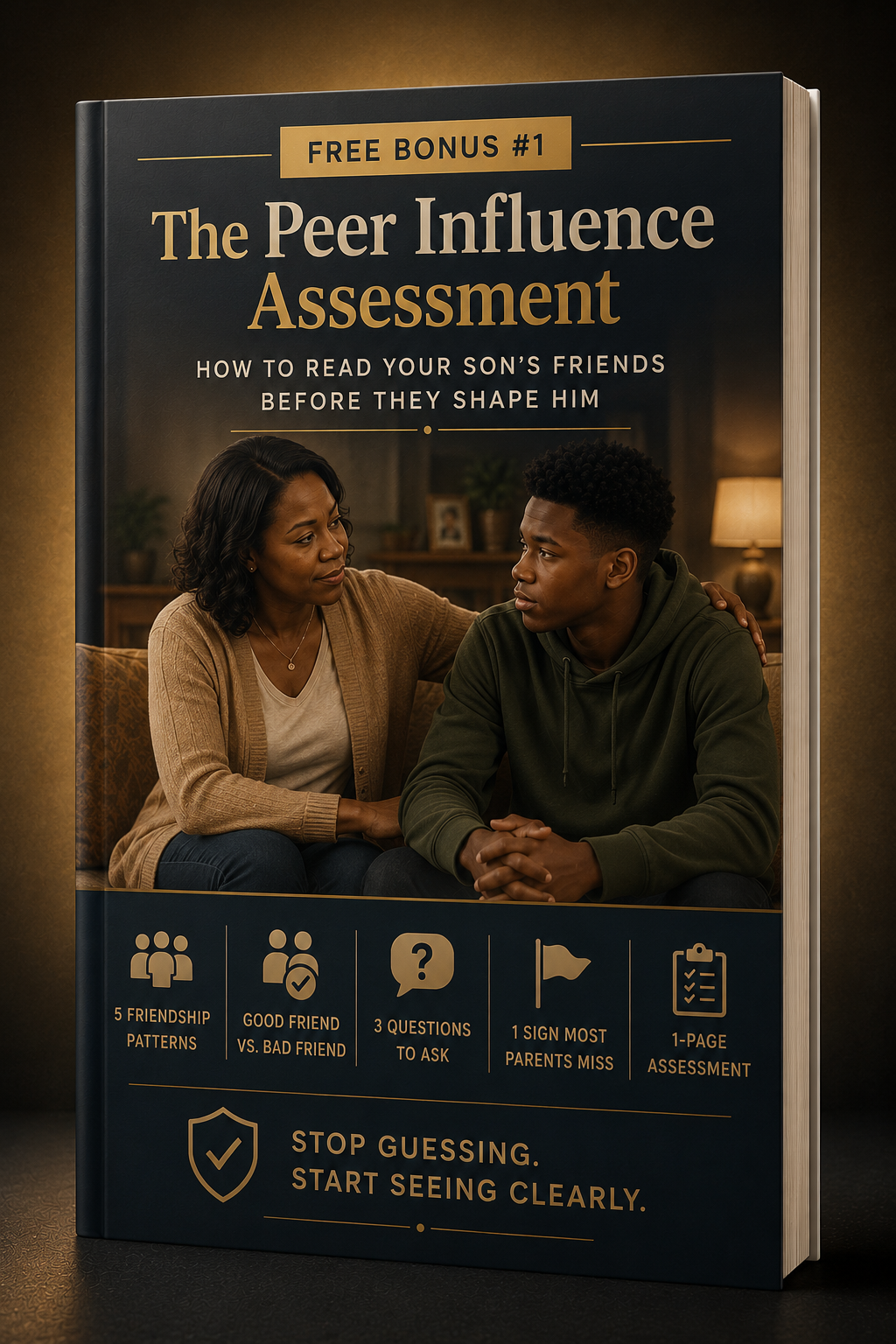
The Peer Influence Assessment: How to Read Your Son's Friends Before They Shape Him
The main guide builds your influence back. This bonus helps you understand the influence competing with yours, because the most dangerous friends are not always the ones who look dangerous at the door.
Most parents watch the obvious boys, the loud ones, the ones who look rough around the edges. They miss the quiet, polite ones who are often the real engine of the group. This bonus shows you exactly what to look for and what to do when you find it.
Valued at $12... yours free today
What this bonus gives you:
- The 5 specific friendship patterns in a teenage boy's social group that research links to substance use risk in African contexts, described in plain language that matches what you can actually observe at home
- How to tell the difference between a friend who is just a bit rough and one who is actively pulling your son somewhere dangerous, because they can look almost identical from the outside
- Three questions you can ask your son about his friends that give you a real picture without sounding like an interrogation
- The one friendship sign that African parents miss most often because in our culture it looks like loyalty
- A one-page assessment you can fill in about the boys your son spends the most time with, so you stop guessing and start seeing clearly

The Crisis Prevention & Recovery Playbook
The main guide builds connection over 30 days. This bonus teaches you how to spot trouble early, repair trust quickly, and keep the door open before it's too late.
Whether you're noticing subtle warning signs, feeling your son pulling away, or you've just had one of those conversations you wish you could take back, this playbook gives you a practical roadmap for what to do next instead of leaving you second-guessing yourself.
You'll learn how to recognise trouble before it becomes a crisis, respond without pushing him further away, and rebuild trust when things don't go as planned.
Valued at $18... yours free today
What this bonus covers:
- The 23 early warning signs that often appear long before substance use begins, including changes in behaviour, friendships, communication, and attitude
- A simple quarterly check-in system that helps you notice patterns early instead of relying on instinct alone
- Exactly what to do after a difficult conversation or argument so one bad evening doesn't undo weeks of progress
- The morning-after repair framework that helps reopen communication without making the situation even more uncomfortable
- What to say, what not to say, and the small actions that rebuild trust faster than another long conversation
- A faith-centered approach to restoring connection naturally, without making your son feel judged or preached at

Everything You Get Today
The guide that closes the gap. The bonus that reads his peer group. The playbook for when things get hard. All three. Today only.
You Might Be Thinking...
"I have already tried so many things. Why would this be different?"
Because most things you tried told you what to do without telling you why nothing was working. This guide starts there. The peer influence bonus shows you who is actually competing with your influence right now. The crisis playbook gives you a practical step for every moment most parents handle wrong. Nothing else puts all three in your hands at once.
"It feels too late. Things have already gone too far."
That feeling is exactly who this guide was written for. There is a full chapter for parents who are past prevention and already in the middle of something. The crisis playbook covers what to say the moment you have already found something or heard something. And remember, the prodigal son came home. His father did not chase him down the road. He kept the door open and waited. This guide shows you how to do that.
"I don't have time for a long programme."
Each day in the 30-day plan is one action, one prayer, one conversation idea. Under ten minutes. The peer influence assessment takes one evening. The crisis playbook is there the moment you need it, not something you have to study in advance. You do not need a free afternoon. You need one decision made tonight.
"What if it doesn't work for my family specifically?"
You get 30 full days to try everything at your own pace with no risk at all. If nothing shifts, not in the guide, not in the conversations, not in the relationship, send a message and get every cent back. No questions. No long process. No argument. The only real risk here is doing nothing while the gap keeps growing.
My Promise to You
Use this guide for 30 days. Follow the daily steps. Do the peer influence assessment this week. Keep the crisis playbook somewhere you can reach it fast when you need it.
If your relationship with your son has not shifted, even a little... if you have not had one real moment of connection that was not there before... send a message and get every cent back. No questions. No long process. No argument.
You have nothing to lose by starting today. The only real risk is doing nothing at all.
But I do not think you will be asking for that refund.
30-Day Money-Back Promise · Instant Access · All Three Included
More from Real Parents
My son is 17 and I found something in his school bag I am not going to describe here. Before this guide I would have erupted and locked him down and we would have gone three more months without a real conversation. Instead I found the right section in the crisis playbook before I even went to speak to him. What to say in the first 60 seconds. I said it. He looked at me differently, then he talked, for over an hour. The door stayed open. I still do not have all the answers but the door stayed open and right now that is everything.
I did the peer influence assessment on the first evening and it completely changed which boys I was paying attention to. The one I had been watching was not the problem. The quiet one, the one who always greeted me politely at the door, was the actual concern. Once I understood that I started having completely different conversations with my son and getting completely different responses. Last Sunday we talked properly for the first time in two years. Not perfectly. But properly. That felt like getting something back I had stopped expecting to see again.
We had a terrible Thursday night. I said things I should not have said and I went to bed knowing I had probably undone two or three weeks of slow progress in one evening. I read the morning-after section in the crisis playbook at 5am before anyone else was awake. I did exactly what it said, no more and no less. When my son came down for breakfast he sat next to me instead of taking his food to his room. He did not say much. But he sat next to me. If you have ever passed a plate through a door that was only open wide enough for the plate to fit, you know exactly why that small thing made me cry into my tea.
A neighbour told me something about my son I was not ready to hear. Without this guide I would have gone home and said everything that was in my chest at once. Instead I found the right section in the crisis playbook for when someone else tells you something and you have to raise it without making your son feel ambushed. I read it three times before I said a word. Then I went home and used it. My son opened up completely that same evening. Two hours. The first real conversation we had had in a long time. That bonus alone was worth more than I paid for everything.
I have wasted money on parenting resources before so I read very carefully now before I spend anything. I almost did not buy this either. But the 30-day guarantee made it feel safe enough to try and I am glad I did. The peer influence assessment in the first bonus showed me in the very first week that I had been looking at my son's world completely incorrectly. I was watching for the wrong things entirely. Once I understood what to actually look for, everything shifted, including the conversations I was able to have with him. Do not let old disappointments talk you out of this one.
Share Your Experience:
You Have Two Choices Right Now.
Option 1: You act today.
You get the guide. You do the peer influence assessment this week and finally understand what is actually shaping your son's choices right now. You have the crisis playbook ready for the moment something goes wrong. You close the gap. You become the voice he hears in his head when someone offers him something dangerous.
You do this now, while the door is still open, while he is still in your house, while there is still time to do this the easy way.
Option 2: You wait.
You close this page. You go back to the same silence. You tell yourself it is a phase and he will come back on his own. And while you wait, the wrong voice gets closer. The gap gets wider. The signs you cannot read keep adding up.
And one day, maybe soon, maybe in a year, maybe in two, something happens that you cannot undo. And you remember this moment. The day the door was still open and you chose to wait.
There are mothers right now who would give everything to go back to the moment you are sitting in. Do not be the mother who looks back at this day.
Teenagers don't stop talking. They simply start talking to someone else. The door is still open. But it will not stay open forever.
Only the first 50 buyers get both free bonuses at $9.97.
After that the price returns to $19.97. 🔒 100% Secure · 30-Day Money-Back Promise · Instant Download
After payment you will receive an email with your download link straight away.
Everything works on any phone, tablet, or computer. No special app needed.
Questions? Email us: familyfirstliving79@gmail.com
Honestly I almost did not read past the first few pages because I have bought things online before that did not deliver. I had already tried two parenting books and sat through a full church seminar and neither gave me one thing I could actually do the next morning. This guide did. By week three my son sat with me in the kitchen and started telling me things that had been happening at school for months. I did not interrogate him. I just listened the way the guide showed me. I also used the peer influence bonus and realised I had been watching completely the wrong boys. That bonus alone changed how I see his whole social world.